Amplifying Refugee Youth Voices and Solutions to Bolster Community Belonging in School Settings
-
Focus Areas
Capacity Building & Leadership, Healthy Communities -
Issues
School-based Efforts
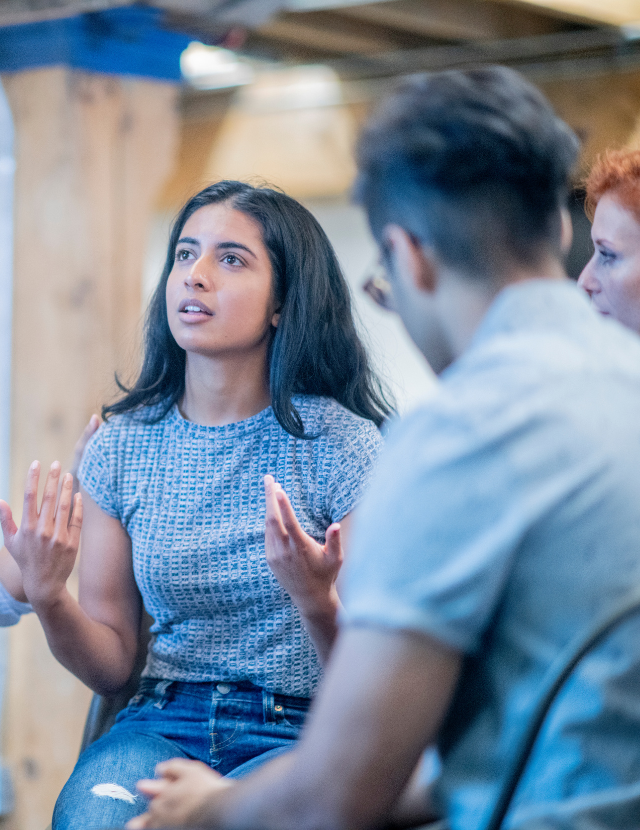
After fleeing war and other conflict or instability, students arriving in new host countries face the challenge of navigating unfamiliar school systems, languages, and cultures. Beyond achieving academic success, these students also need something just as vital to their well-being: belonging.
In 2024, PHI’s Center for Immigrant and Refugee Health hosted their annual conference featuring a student-led discussion where refugee and immigrant students courageously shared their personal histories and the lived experience of their journeys to California. During the conference, panelists highlighted dedicated educators and school practices that helped them succeed, both academically and emotionally.
Refugee students are experts in their own experiences and their voices advocate not only for themselves but also for future generations of students like them. With language support, community building, mental health care, and inclusive educational environments, schools are transformative agents helping newcomer students thrive.
See highlights from the panel discussion to understand what refugee students want schools to know and explore the full story on the CIRH website for further resources for teachers, administrators, counselors and community partner to help build school environments where refugee and immigrant students are truly seen, heard and empowered.
Support Language and Academic Growth
For many, adjusting to a new academic system can be overwhelming, especially when it comes to learning a new language. CIRH’s student conference panelists share here how personalized and flexible support positively impacted their academic experience:
When I just started school in Denmark, I only spoke Ukrainian and you have few words in English, so I couldn't study like the other students. The teachers were really patient in helping me to adapt. They gave me extra homework and allowed me to complete assignments in English.Refugee Student, CIRH’s 2024 Annual Conference
I think having someone you can talk to about your problem is helpful. When I got a D in chemistry, the teacher let me use a translator, which helped.Refugee Student, CIRH’s 2024 Annual Conference
There were tutoring programs and other programs that brought the Muslim community students together. A lot of newcomers who don't speak English like me come together every week to help each other.Refugee Student, CIRH’s 2024 Annual Conference
The free after-school tutoring made schoolwork a lot more accessible to students like me. When I was in high school, college readiness programs for underrepresented students, such as going on campus tours, having people help us with our applications, and getting fee waivers for tests helped level the playing field. I think those free school-based programs that help kids who don't have those resources are super helpful, especially for people who are in the diaspora.Refugee Student, CIRH’s 2024 Annual Conference
Knowledge about how the school system worked, such as how teachers teach, how grades are given, what happens during lunch, and what the office does, and how wellness programs work is helpful. I didn't have anyone to explain all these things, so it took me about one or two months to fully adapt to the new school system. Providing more information on free education, work opportunities for parents and students, and housing options like shelters for refugees would be useful.Refugee Student, CIRH’s 2024 Annual Conference
Build Community Connections
Students emphasize how meaningful connections with peers, staff, and cultural community members help them feel safe, seen, and welcome.
When I arrived, my mom took me to Ukrainian kids' meetups, such as dancing or language classes. I didn't know English yet and it was nice to have a group of peers who I could communicate with while I was learning how to communicate with my American peers. I think that really fostered a sense of community and helped me integrate into my new environment.Refugee Student, CIRH’s 2024 Annual Conference
We learned so much by asking others, including people who had lived in the country for a long time, including other refugees. Sometimes we asked our social workers for help, and so they shared with us their experience or told us whom we could talk to know about some things that we were interested in.Refugee Student, CIRH’s 2024 Annual Conference
The best way for us was to ask people who were familiar with how things worked. People often say the best way to learn is by asking someone who knows, and that was definitely true for us. Talking to others and asking questions were the most helpful way to understand the system for me and my family.Refugee Student, CIRH’s 2024 Annual Conference
I found people like me through the ELD program at my school. We basically grew together and learn English together. The Refugee Resettlement programs also helped find where the doctors' offices were, how to ask for medical support at the doctor's office, and how to look for work and find employment.Refugee Student, CIRH’s 2024 Annual Conference
Prioritize Mental Health and Healing
Students share the importance of safe spaces and the impact made by trusted adults who recognized their emotional needs, especially in processing trauma, family separation, and/or sudden life changes.
I wish I had mental health counseling at school. Because I had good grades, no one really understood that I was also mentally struggling. I also wish that it was easier as an immigrant to access the DSP program because I didn't know it at the time, but I did have a learning disability.Refugee Student, CIRH’s 2024 Annual Conference
In Afghan culture, we don't talk much about mental health. But there are a lot of Afghan people who came as refugees in the past three years who suffer from mental health, for example, anxiety and depression. I didn't know what mental health was, how to express myself, or how to talk about my emotions. Then there were the school programs that taught us about mental health and how to express it and address the symptoms, which helped a lot.Refugee Student, CIRH’s 2024 Annual Conference
It helps a lot of the refugee students to know how to express themselves when they're having symptoms of mental health issues and have someone from the same culture to talk to and open up to.Refugee Student, CIRH’s 2024 Annual Conference
Teachers should understand what refugee students are going through and how that impacts their well-being, grades, their ability to succeed academically. We need to have better communication between teachers and students.Refugee Student, CIRH’s 2024 Annual Conference
School should educate faculty and staff on cultural sensitivity and what it means to have a culturally inclusive and culturally affirming educational environment. I think making space for students to express themselves and facilitating occasions where refugee and immigrant students can meet others with similar backgrounds can make the transition feel less isolating. Having a basis of understanding and cultural competency is really important for peers as well as educators and providing outlets for students to share and process their stories, making sure that school faculty are educated about where students come from. A personal experience is when I moved and went to middle school here, I was too scared to tell people that half of my family was Muslim because I feared the Islamophobia that I had witnessed and that I knew existed here. I think just having general education about certain religions or cultures can make it feel safer for refugee and immigrant students to share more about themselves.Refugee Student, CIRH’s 2024 Annual Conference
A version of this impact story first appeared in a Center for Health and Refugee newsletter and on their website.
Work With Us
You change the world. We do the rest. Explore fiscal sponsorship at PHI.
Support Us
Together, we can accelerate our response to public health’s most critical issues.
Find Employment
Begin your career at the Public Health Institute.