Blog: Multi-Sector Blueprint for Community-Owned Climate Resilience
This blog from PHI CEO Melissa Stafford Jones and Build Healthy Places Co-Executive Director Colleen Flynn examines how cross-sector public health partnerships can provide a foundation for community-led resilience to climate disasters.
-
Focus Areas
Environmental Health -
Issues
Climate Change, Wildfires & Extreme Heat -
Expertise
Coalition & Network Building -
Programs
Build Healthy Places Network
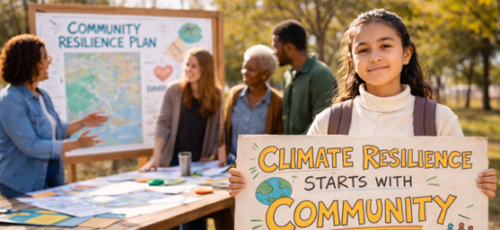
Climate-driven disasters are no longer abstract future threats. Communities across the country are contending with extreme heat, flooding, wildfires and cascading impacts on public health, often with systems that were never designed to protect those most at risk. As these challenges accelerate, there is urgency to move beyond fragmented responses and toward approaches that are coordinated, fair and led by the communities most impacted.
It is within this context that Build Healthy Places Network, a program of the Public Health Institute, held its virtual Summit, Building Resilient Communities: A Multi-Sector Approach to Navigating Climate-Driven Disasters. The Summit convened public health, community development, healthcare, local government, philanthropy and community leaders to examine what it takes to move from ideas to action grounded in community ownership. The blueprint here reflects the Summit’s core questions—how multi-sector partnerships can align around shared goals, embed equity into implementation and build resilience that lasts.
Climate resilience—the proactive, community-driven process of strengthening systems to withstand the impact of climate-caused emergencies—is a public health imperative. It aims to redress historical injustices by distributing resources fairly, ensuring marginalized communities hold decision-making power, and prioritizing benefits for those who need them most.
As heat waves, floods, wildfires and shifting disease patterns intensify, decades of decisions about where to invest and who to protect have left entire neighborhoods exposed. The path forward must be led by multiple sectors working alongside residents who know their neighborhoods best— with communities shaping and controlling their own data, designing strategies and holding governing authority.
Public health convenes diverse partners, translates science into practical guidance and monitors health outcomes to surface inequities. Yet resilience requires more than public health alone—it demands a networked approach that blends data, resources and infrastructure with community knowledge. Community land trusts, local governance mechanisms, resident-led coalitions and resident-led budgeting processes root resilience in trust, protect community wealth and prevent the withdrawal of resources.
A multi-sector alliance accelerates action by aligning investments, policies and on-the-ground practices with the realities communities face—from housing displacement and food access to childcare gaps. It bridges prevention and response, ensuring that what happens before a disaster reduces harm, and what happens after supports recovery for those most affected.
What This Looks Like in Practice

Maine: Public Health as a Pillar for Climate Resilience
Public health anchors Maine’s climate effort through the Community Resilience, Public Health, and Emergency Management Working Group, providing surveillance, multilingual education and equitable resource distribution as the foundation for a just and lasting climate transition. Ambitious targets back the effort: 45% emissions cuts by 2030, carbon neutrality by 2045, and 100% renewable energy by 2050.

Altadena: Building a Community Land Trust to Protect People and Place
Altadena’s effort focuses on preventing displacement in fire-prone neighborhoods by tying housing stability to local wealth-building, climate adaptation and the creation of a Community Land Trust (CLT). The CLT would hold land for long-term affordable housing, keeping homes in community hands even as property values rise post-disaster, and ensuring governance stays with residents. By safeguarding homes and guiding inclusive redevelopment, the CLT protects health, strengthens community networks and preserves wealth-building opportunities for communities long excluded from homeownership.

Eastside Detroit: Resilience Hubs for Community-Powered Protection
Eastside Detroit showcases a multi-sector network that builds solar-powered resilience hubs designed to shelter residents during floods, heat waves and outages. Hospitals, housing organizations and city agencies coordinate to deliver cooling, health information and essential services at scale. These hubs are more than physical spaces; they operate as governance platforms with resident input, data-sharing agreements and clear coordination protocols to ensure equitable access to relief.
A Shared Vision for Multi-sector Climate Action
We envision a multi-sector approach where community members, local associations and neighborhood networks lead and shape resilience efforts. They will drive data and surveillance, co-design risk services, govern implementation, ensure accountability and direct benefits to those most affected.
- Public Health: anchors multi-sector collaboration by convening actors, translating risk into practical guidance and stewarding indicators to identify needs and ensure prevention and recovery are provided to those who need it most.
- Community Development: leads housing and infrastructure stability and implements energy-efficient and climate-resilient upgrades; mobilizes trusted networks to plan risk reduction, evacuation and recovery while preserving affordability and preventing displacement.
- Healthcare: enhances system durability and readiness for climate disasters deploys resources for pre-disaster housing security and connects care to address the core social and environmental drivers of poor health.
- Local Government: aligns codes, zoning and emergency planning; and ensures transparent, data-informed resource allocation during crises.
- Philanthropy: funds multi-sector capacity-building and pilots that center community ownership and sustain long-term impact.
Together, these sector roles—and authentic community leadership—turn pilots into durable, scalable resilience that reflects local needs and values.
From Blueprint to Action
The moment calls for practice over promises. Co-design with community members so they define success, test solutions and co-manage data for accountability. Align funding with community priorities through intermediaries that connect health, housing and local government and invest in data infrastructure communities control. Build replicable frameworks—governance models, data-sharing approaches, community-informed budgeting—adaptable across neighborhoods with different histories and needs.
Colleen Flynn is the Co-Executive Director for the Build Health Places Network, a program of the Public Health Institute (PHI). Melissa Stafford Jones is the President and CEO of PHI.

Work With Us
You change the world. We do the rest. Explore fiscal sponsorship at PHI.
Support Us
Together, we can accelerate our response to public health’s most critical issues.
Find Employment
Begin your career at the Public Health Institute.