
The legal cannabis market in California has grown enormously. What are communities doing to protect youth, public health and equity? These scorecards, produced by PHI’s Getting it Right from the Start, evaluate the policies passed by California cities and counties that allow cannabis sales, rating them on a 100-point scale.
The scorecards highlight jurisdictions that are making positive steps in adopting cannabis regulations that protect youth, public health and equity—and demonstrate the gaps in protections in many other localities. This provides policymakers, health advocates and others the only comprehensive guide to understanding and comparing the policies and trends on cannabis regulations throughout the state.
Explore the Scorecards
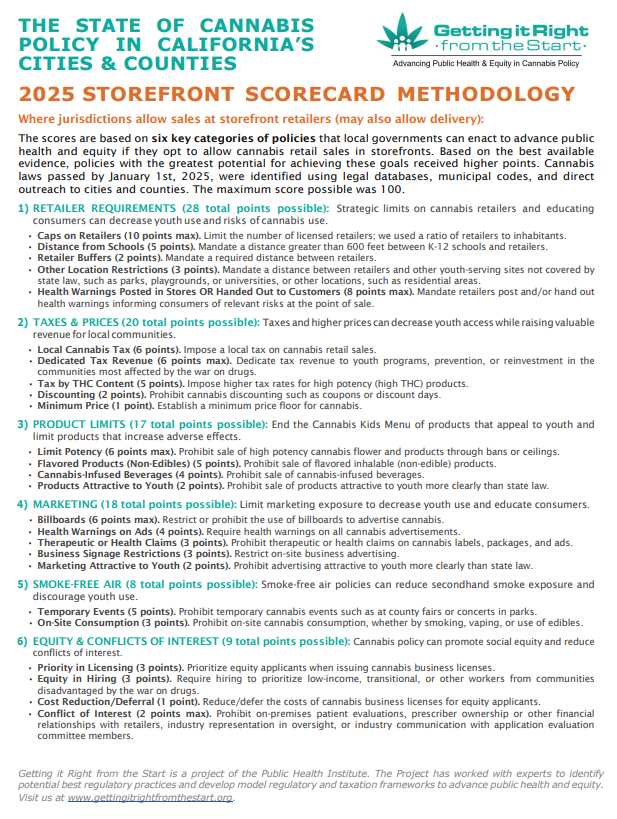
Learn more: Review the scoring methodology; see best practices in action, explore scores by region; or view the full press kit and fact sheet.
The 2025 scorecards assess jurisdictions on a 100-point scale, with higher scores representing stronger public-health protections enacted as of January 1, 2025. Evaluations are based on six policy areas: retailer requirements; local taxation; product regulations; marketing restrictions; smoke-free air protections; and equity measures. The City of Pomona topped this year’s scorecard with 60 points, reflecting a comprehensive approach to public health and equity. Pomona caps the number of retail licenses, bans temporary cannabis events and on-site consumption, requires a 1,000-foot buffer from schools and other youth-sensitive sites, mandates in-store health warnings, prioritizes equity in hiring with fee deferrals, and dedicates local cannabis tax revenue to youth programs and prevention. San Benito County, which allows delivery-only sales from outside jurisdictions, earned the highest score among delivery-only jurisdictions for the sixth consecutive year (2020–2025), with 39 points.
See more highlights:
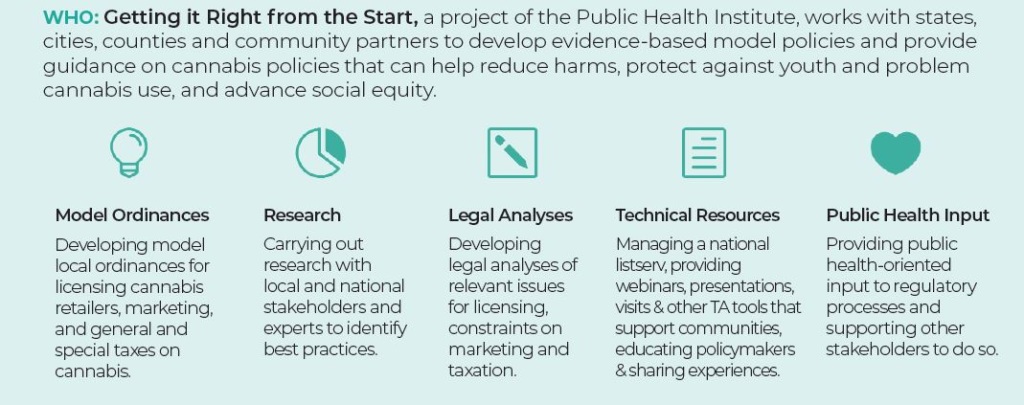
To assist local governments, Getting it Right from the Start offers model policies for cannabis retailing, marketing and taxation that cities and counties can adopt. They also offer complementary resources and expert technical assistance to state and local regulatory agencies, policymakers and their staff, as well as community organizations and advocates.
The 2024 Scorecards revealed that only 14 of California’s 539 localities enacted any cannabis product restrictions despite strong evidence supporting action on issues like potency and youth-appealing flavors. See the 2024 Scorecards.
The 2023 Scorecards revealed that only 10 of 539 localities enacted any cannabis product restrictions—illustrating the enormous space for local action. See the 2023 Scorecards.
Originally published by Getting it Right from the Start
You change the world. We do the rest. Explore fiscal sponsorship at PHI.
Together, we can accelerate our response to public health’s most critical issues.
Begin your career at the Public Health Institute.